The lifecycle flow shown here is being removed in a near-future release, but it is still important because it explains the current client and server flow in the 2025-11-25 specification. When a new MCP server is added in Cursor, the first interesting thing is not a tool call. Cursor starts by probing the server shape, negotiating the MCP session, and discovering what the server exposes. The screenshots below capture both sides of that sequence for a simple local server built with PyMCP Kit, the framework I am using while implementing the MCP spec and tracing real MCP request flows. The terminal screenshots show what the server receives over Streamable HTTP. The Cursor screenshots show what those protocol messages turn into inside the client.
PyMCP Kit is my capability-first MCP server toolkit for FastAPI. It supports Streamable HTTP and stdio, tool/prompt/resource registries, roots, resource subscriptions, task-aware execution, optional auth hooks, and capability advertising. If you want to inspect or build against the same framework used for this trace, check out github.com/Agent-Hellboy/py-mcp.
This trace uses the published MCP lifecycle specification version 2025-11-25 as the reference point. That lifecycle still defines three phases: initialization, operation, and shutdown. Initialization is where the client and server agree on protocol version, exchange capabilities, and share implementation details. After the server answers initialize, the client sends notifications/initialized before normal operation begins.
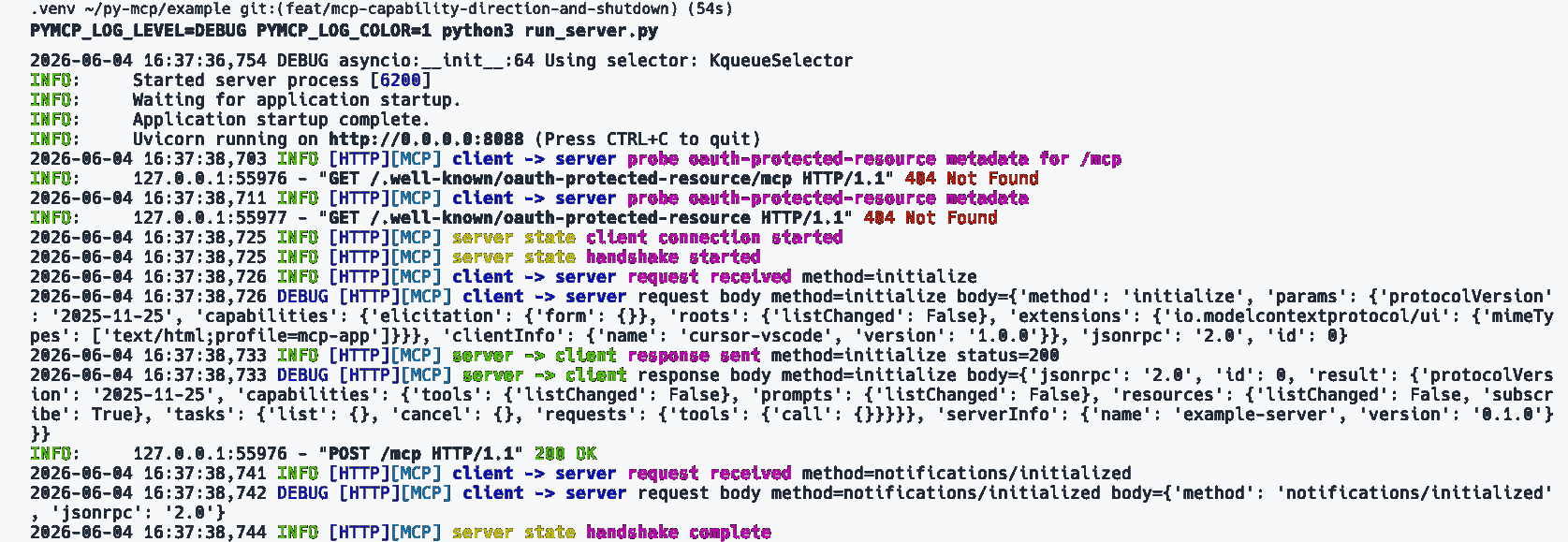
The first two requests are probes against standard OAuth protected-resource metadata endpoints: /.well-known/oauth-protected-resource/mcp and /.well-known/oauth-protected-resource. Both return 404 Not Found in this run. For this local unauthenticated server, that is expected: the server is not exposing OAuth metadata. Cursor then opens the MCP session with initialize.
In the observed initialize request, Cursor identifies itself as:
{
  "name": "cursor-vscode",
  "version": "1.0.0"
}
It also advertises client capabilities, including elicitation, roots, and an extension capability for MCP UI/App-style content: io.modelcontextprotocol/ui and text/html;profile=mcp-app
That is the important signal in this trace: Cursor is not just asking for tools. It is announcing capability-level support for richer MCP UI/App content negotiation.
After the server responds to initialize, Cursor sends: notifications/initialized
That marks the end of the handshake and the start of normal MCP operation.
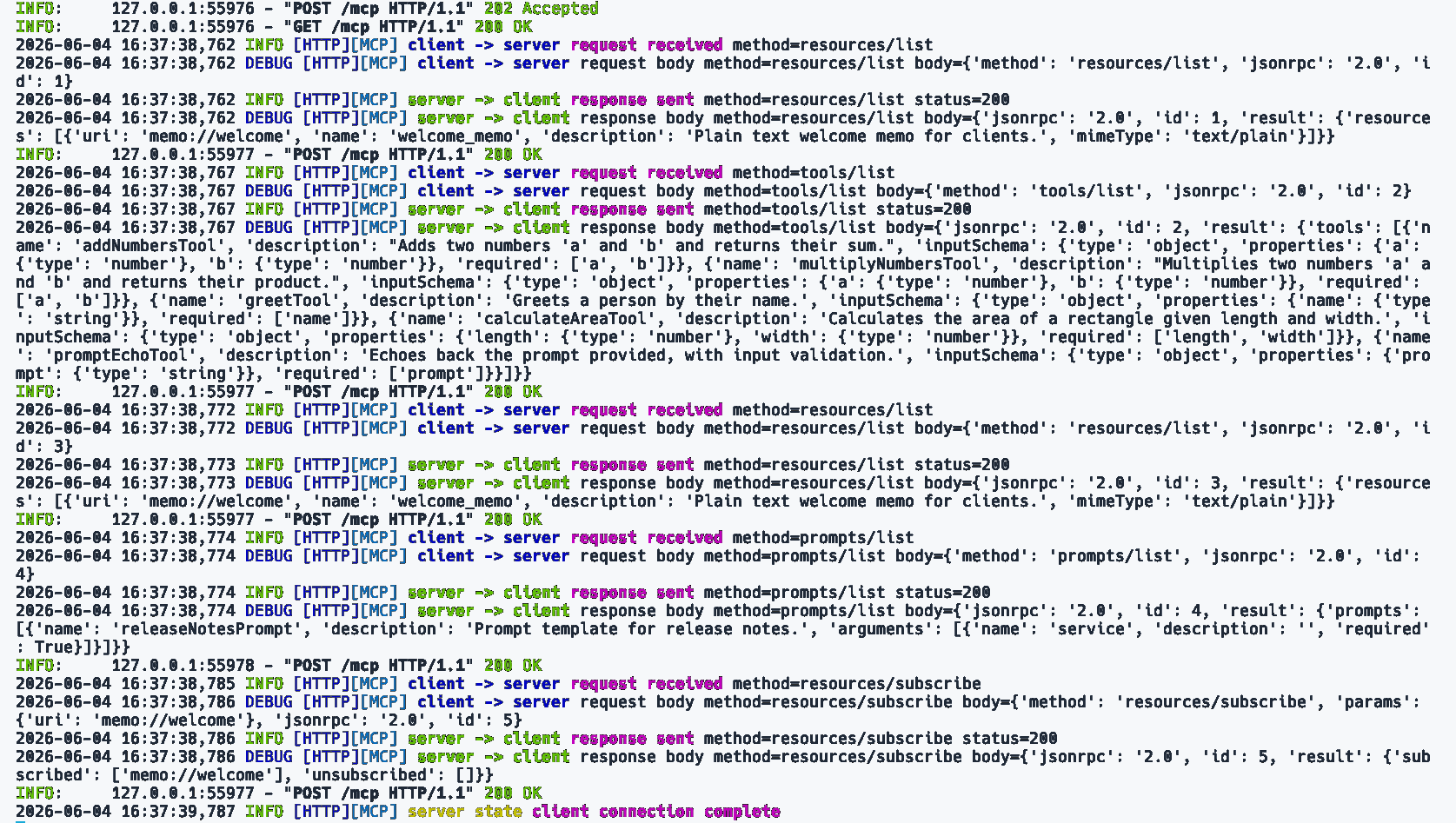
Once initialized, Cursor immediately performs discovery: resources/list, tools/list, resources/list, prompts/list, and resources/subscribe.
The duplicate resources/list is visible in the trace. Cursor first reads available resources, then tools, then resources again, then prompts. Finally, it subscribes to the resource memo://welcome.
The server responds with a resource named welcome_memo, several tools, and a prompt template. At this point Cursor has enough inventory to decide what it can show or call in the client.
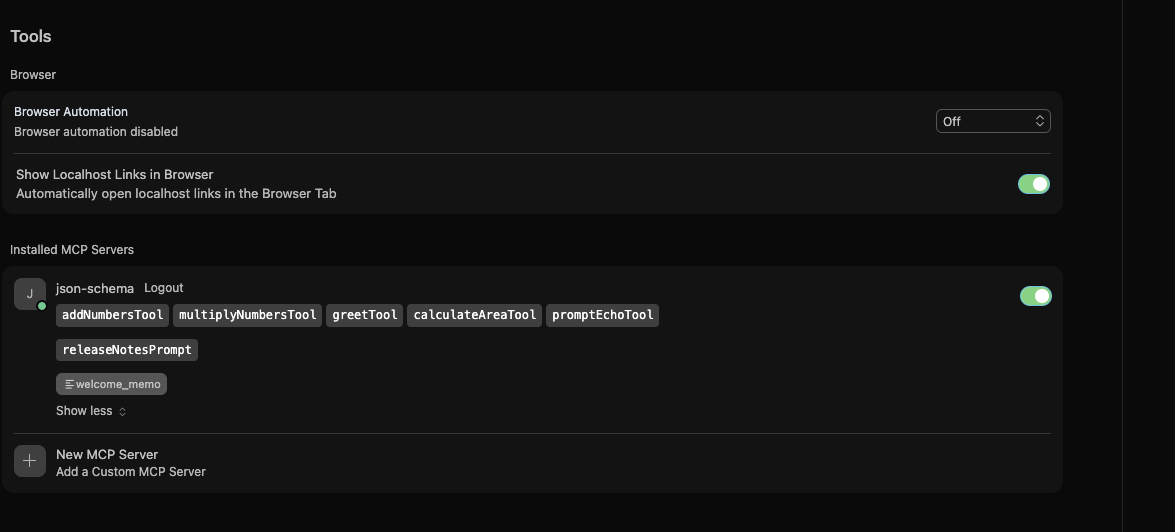
This is the client-side result of discovery. Cursor now shows the server as json-schema, and the inventory from tools/list, prompts/list, and resources/list is visible in the MCP settings UI: addNumbersTool, multiplyNumbersTool, greetTool, calculateAreaTool, promptEchoTool, releaseNotesPrompt, and welcome_memo.
That matters because this is where the abstract JSON-RPC discovery calls become actual client affordances. The server did not just respond with data; it gave Cursor enough structured metadata to expose callable tools, a prompt, and a resource to the user.

After discovery, user or client activity can produce normal operation requests. In the server trace below, Cursor calls tools/call.
The tool is addNumbersTool, with arguments a = 5 and b = 6. The server returns a JSON-RPC result containing Sum of 5 + 6 = 11.
That shows the request has moved out of startup discovery and into ordinary MCP operation. The client has selected a discovered tool, sent a JSON-RPC tools/call, and received tool output as normal MCP content.
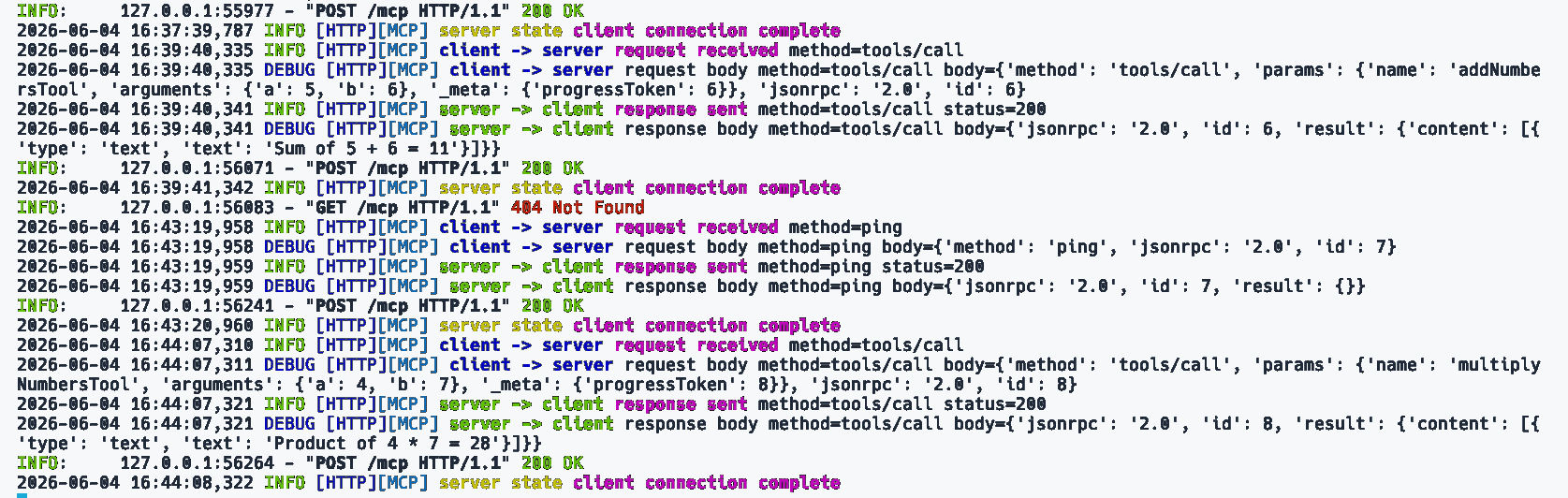
The last screenshot shows two useful follow-up behaviors. First, Cursor sends ping.
The server returns an empty result, confirming the session is still alive. Then Cursor calls another tool: multiplyNumbersTool.
The response contains Product of 4 x 7 = 28.
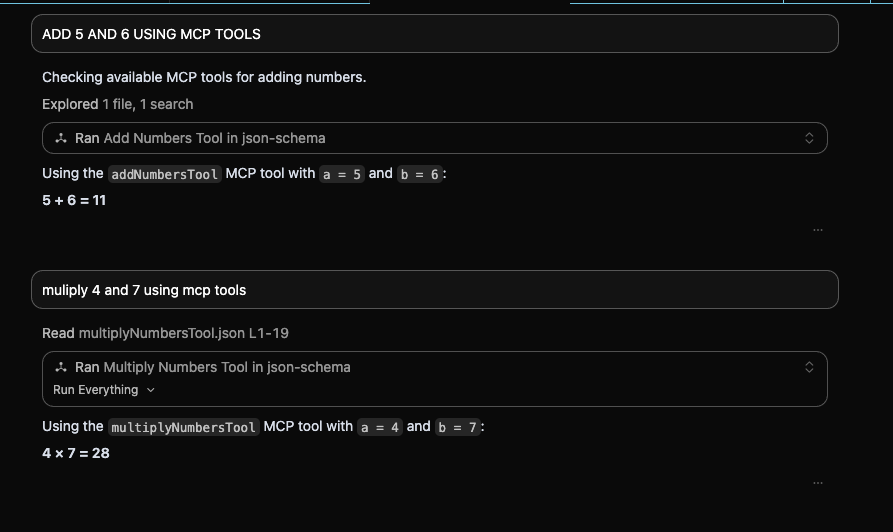
This is the same behavior from the Cursor chat view. Cursor first checks available MCP tools for the request, then runs the matching tool from the json-schema server:
Ran Add Numbers Tool in json-schema
Using the addNumbersTool MCP tool with a = 5 and b = 6
5 + 6 = 11
The second prompt does the same thing for multiplication:
Ran Multiply Numbers Tool in json-schema
Using the multiplyNumbersTool MCP tool with a = 4 and b = 7
4 x 7 = 28
So the full flow is visible in both places: the server logs prove the Streamable HTTP JSON-RPC request path, while Cursor proves that the discovered tool schema was usable enough for the client to select and execute the right MCP tool.
So the complete observed startup and early operation flow is: OAuth metadata probe, initialize, notifications/initialized, resources/list, tools/list, resources/list, prompts/list, resources/subscribe, ping, and tools/call.
The final client connection complete log means Cursor stopped sending startup discovery requests after the initial MCP session setup. This sequence is not a convention — it is what the 2025-11-25 spec requires clients to do, and what spec implementers like PyMCP Kit must respond to correctly. An MCP server implementation has to handle the OAuth metadata probes (returning 404 is valid for unauthenticated servers), respond to initialize and notifications/initialized in order, and serve resources/list, tools/list, and prompts/list before any tool call arrives. Clients follow this flow because the spec mandates it, so the implementation must support it end to end.
The lifecycle flow is getting removed in a near-future release, but this article is still important because it explains the current client and server flow in the 2025-11-25 specification. SEP-2575: Make MCP Stateless is final, and it removes the stateful initialization handshake in the next protocol direction: initialize / notifications/initialized.
Under that SEP, protocol version moves to per-request metadata, capability discovery moves to server/discover, resources/subscribe is replaced by the subscriptions/listen model, and ping is removed because normal RPC calls and transport-level keepalive mechanisms already prove liveness.
So treat this trace as a compatibility snapshot of the current 2025-11-25 lifecycle: it documents how Cursor starts an MCP session over Streamable HTTP today, while also showing the exact machinery that the stateless MCP direction is deprecating and removing in the future release line.
Comments
0 commentsNo comments yet.